

Gas Turbines Are Back: The Value Chain Powering AI
A condensed English adaptation of CPEM Power Generation Think Tank’s industry-chain report, updated with current market evidence and GX’s latest perspective.[1]
AI’s next constraint is not only compute. It is power that can be financed, permitted, delivered, and operated at scale.
The International Energy Agency expects global data-center electricity consumption to roughly double from 485 TWh in 2025 to 950 TWh in 2030, while electricity use at AI-focused data centers triples over the same period.[2] Behind that growth sits a less visible industrial story: turbines, hot-section components, generators, heat-recovery systems, controls, transformers, and the service networks that keep them running.
Gas turbines are an old technology with a new strategic role. They can provide large blocks of dispatchable power, support grids with rising renewable penetration, and serve as on-site or bridge generation for energy-intensive infrastructure. At the same time, the industry is capacity-constrained. GE Vernova reported 122 GW of Gas Power equipment backlog and slot reservation agreements at the end of the third quarter of 2026—a figure that combines firm backlog with reservations and therefore should not be read as firm orders alone.[3]
This creates two simultaneous truths. Gas turbines have become one of the most important platforms for the AI power buildout, and access to equipment has become a project risk in its own right.
For GX, the technology question is therefore not simply which machine has the best brochure efficiency. It is which power architecture can deliver reliable capacity, operational flexibility, and bankable lifecycle performance at the scale AI infrastructure now requires.
1. Why Gas Turbines Matter Again

A gas turbine converts fuel into mechanical power through the Brayton cycle: a compressor pressurizes incoming air, a combustor adds heat, and a turbine extracts energy from the expanding gas. A generator then converts that mechanical power into electricity.
The basic principle is well established. The strategic value comes from how differently the technology can be configured.
Platform | Defining characteristics | Best-fit applications |
Heavy-duty gas turbines | Large unit output; highest efficiency in combined-cycle configurations; deep utility and EPC ecosystem | Utility-scale generation, large data-center campuses, grid firming, coal-to-gas transitions |
Aeroderivative gas turbines | Adapted from aircraft-engine technology; high power density; modular packaging; fast start and ramp capability | On-site data-center power, bridge power, peaking, backup, oil and gas, marine and remote facilities |
Industrial and small gas turbines | Rugged designs; broad range of outputs; often integrated with heat recovery | Industrial self-generation, combined heat and power, oil and gas facilities, distributed energy |
Microturbines | Small, modular units with lower individual output | Niche distributed generation, commercial facilities, specialized backup and heat-recovery applications |
The top of the market illustrates the scale advantage. GE Vernova’s 9HA platform is rated at 448–571 MW in simple cycle and above 64% efficiency in specified combined-cycle configurations.[4] These are project- and configuration-dependent ratings, not universal field results, but they show why heavy-duty turbines remain central to large power systems.
Aeroderivative machines solve a different problem. Selected GE Vernova models can start in approximately five minutes, while mobile and factory-assembled packages can reduce site integration work.[5] When paired with batteries, the battery can provide instantaneous response while the turbine supplies sustained generation.
Gas turbines therefore should not be understood only as legacy baseload equipment. They can perform four roles in the emerging power system:
1. Scale: delivering large, continuous blocks of power.
2. Flexibility: ramping and starting to complement variable renewables and changing loads.
3. Resilience: supporting islanded, grid-parallel, backup, or hybrid architectures.
4. Transition: providing a pathway from today’s natural-gas system toward lower-carbon fuels, although the pace and economics of that pathway remain uncertain.
2. Inside the Gas Turbine Value Chain

The gas turbine is not a single product. It is the visible output of one of the most demanding industrial supply chains in the world.
Upstream: Materials Determine the Performance Ceiling
The hot section operates under extreme temperature, pressure, and mechanical stress. Its performance depends on nickel-based superalloys, single-crystal and directionally solidified blades, powder-metallurgy discs, ceramic matrix composites, thermal-barrier coatings, specialty steels, titanium alloys, and tightly controlled inputs such as rhenium.
These materials are not interchangeable commodities. A turbine’s efficiency and durability depend on alloy composition, casting yield, crystal orientation, coating adhesion, cooling-channel geometry, inspection accuracy, and process repeatability. A technically successful prototype is not the same thing as a stable production line.
This is why materials and process knowledge create such durable barriers to entry. The critical asset is often not merely the furnace or casting line, but decades of process data and field feedback.
Core Components: The Hot Section Is the Bottleneck
Turbine blades, guide vanes, combustors, discs, casings, controls, and heat-recovery equipment each require specialized manufacturing and qualification. Hot-section components are particularly difficult because their supply chains overlap with aerospace engines and require long qualification cycles.
The result is a value chain in which the OEM does not control every constraint. A complete turbine can still be delayed by a limited number of qualified suppliers, inspection capacity, specialized forgings, or coatings.
For project developers, this means procurement diligence must extend below the nameplate OEM. For investors and supply-chain partners, it means value can accrue to highly specialized component manufacturers—not only to the company whose logo appears on the turbine.
Midstream: OEM Scale and Service Depth Matter
The global heavy-duty market is led by GE Vernova, Siemens Energy, and Mitsubishi Power, with other important positions held by companies such as Baker Hughes, Solar Turbines, and Ansaldo Energia across aeroderivative, industrial, and heavy-duty segments.
Their advantage is not only machine design. It is the combination of installed fleets, operating data, engineering standards, parts networks, field teams, and long-term service agreements. A data-center customer is not buying a one-time thermal reaction; it is entering a decades-long operating relationship.
Downstream: Lifecycle Service Is Part of the Product
Hot-gas-path inspections, major overhauls, spare parts, controls, remote monitoring, upgrades, and outage planning shape the real cost and availability of a plant. Equipment price alone cannot capture this value.
A lower-efficiency machine with secured parts and service may outperform a theoretically superior machine whose maintenance ecosystem is not available when needed. The correct procurement metric is therefore not simply dollars per kilowatt, but reliable, delivered energy over the asset’s operating life.

3. China’s Opening: Components First, Complete Machines Next
The source report maps a broad Chinese ecosystem spanning superalloys, precision castings, forgings, casings, controls, heat-recovery boilers, complete turbines, and project integration. It identifies companies including CISRI-GAONA, Fushun Special Steel, Yingliu, Himile, Hangyu, Dongfang Electric, Shanghai Electric, and Harbin Electric as examples of participants at different points in that ecosystem.[6]
The most important strategic signal is that Chinese component suppliers may enter global supply chains before Chinese complete-machine platforms achieve broad international acceptance. Qualification as a component supplier can create operating references, quality-system credibility, and long-term customer relationships without requiring an overseas customer to adopt an entirely new turbine platform.
Complete machines present a harder challenge. China has made progress in small and medium-output turbines and in F-class heavy-duty technology, but the next stage depends on repeatable manufacturing, high-temperature materials, long-duration operating validation, and localized service. H-class competitiveness cannot be established by a successful full-load test alone.
The GX takeaway is disciplined rather than promotional: China’s opportunity is real, but qualification must be evaluated platform by platform and component by component. The credible pathway is not “replace every incumbent OEM immediately.” It is to build trusted capacity where customers face genuine shortages, then convert that trust into longer-term supply and service relationships.
4. Demand Is Strong—but On-Site Gas Is Not Automatically Fast Power

AI data centers are the most visible new source of demand, but they are not the only one. Grid balancing, coal retirement, industrial electrification, oil and gas production, and replacement of aging turbine fleets all compete for manufacturing capacity.
That matters because a gas turbine strategy can fail at the procurement stage. The IEA cautions that reliable on-site gas generation for critical and variable data-center loads may require 30–70% more installed capacity than the load itself, depending on architecture and redundancy. It also estimates that 15–27 GW of on-site natural-gas capacity could serve data centers by 2030, mostly in the United States, while emphasizing that turbine scarcity means on-site generation does not necessarily provide a faster route to market.[7]
This is an essential correction to a simplistic narrative. Gas turbines can enable on-site power, but buying on-site equipment does not eliminate time-to-power risk. Developers must secure not only a turbine slot, but also gas supply, emissions permits, interconnection or islanding approvals, EPC capacity, transformers, switchgear, controls, commissioning, redundancy, and long-term service.
The winners will be the teams that integrate these workstreams early.
5. Gas Turbines vs. SOFC: The Comparison That Actually Matters
Solid oxide fuel cells convert fuel into electricity electrochemically rather than through combustion. They are modular, quiet, highly efficient in suitable configurations, and produce very low local criteria pollutants. Bloom Energy’s current Energy Server 6.5 datasheet, for example, specifies a 325 kW unit, cumulative electrical efficiency of 65–53% on an LHV net-AC basis, no water use during normal operation, and 308–378 kg/MWh of CO₂ when operating on natural gas at the stated efficiency.[8]

Those are meaningful advantages. But they do not settle the question of which technology should anchor a large AI campus.
Dimension | Gas turbines | Solid oxide fuel cells |
Scaling architecture | Large power blocks; heavy-duty units reach hundreds of MW, and plants can be configured at GW scale | Small modular units aggregated into larger systems; excellent for phased deployment, with more repeated units and integration points |
Electrical efficiency | Lower in simple cycle; leading combined-cycle configurations exceed 64% under specified conditions | High at distributed scale; product ratings must be read across the stated cumulative-efficiency range and on a consistent LHV/HHV basis |
Operational flexibility | Aeroderivative models can start in minutes; heavy-duty combined-cycle plants can provide both efficient output and substantial ramping capability | Best known for steady distributed generation; modern systems can support load following, but project-level response, redundancy, and battery integration still require engineering |
Deployment today | Factory-assembled and mobile packages can accelerate installation, but current turbine slots and supply chains are constrained | Modularity can shorten deployment where equipment, gas, permits, and site infrastructure are available; Bloom and Oracle initially announced a 90-day deployment objective for selected projects[9] |
Local emissions and water | Combustion produces CO₂ and requires NOx management; water use depends on configuration and emissions/cooling design | Very low criteria pollutants and no normal-operation water use in Bloom’s specification; still produces CO₂ on natural gas |
Fuel pathway | Natural gas, liquid fuels on suitable models, and hydrogen blends on specified platforms; GE rates 9HA as capable of up to 50% hydrogen with a technology pathway toward 100%[10] | Natural gas, biogas, blended hydrogen, or hydrogen depending on system configuration; hydrogen supply economics remain decisive |
Lifecycle model | Mature global service ecosystem; planned hot-section maintenance and overhaul costs are central to economics | Modular redundancy and fewer rotating parts are attractive; degradation, stack condition, replacement obligations, and lifetime service cost must be explicitly modeled |
Best-fit role | Large-scale primary power, grid firming, flexible generation, and integrated hybrid plants | Distributed primary power, fast modular additions, sites with stringent local-air-quality or water constraints, and targeted resilience applications |
SOFC’s commercial momentum also deserves recognition. In April 2026, Bloom and Oracle announced an expanded master agreement supporting up to 2.8 GW of fuel-cell capacity, including an initial contracted 1.2 GW.[11] SOFC is therefore not a laboratory curiosity or a niche backup product. It is becoming a meaningful part of the AI power mix.
The GX conclusion is nevertheless favorable to gas turbines at scale—not because SOFC lacks merit, but because large AI infrastructure requires more than modular efficiency.
Gas turbines offer a stronger combination of unit scale, fast mechanical response in appropriate configurations, high combined-cycle efficiency, multiple plant architectures, and a mature global service ecosystem. They can anchor a campus, support a grid, or operate within a hybrid system. Their principal weaknesses—equipment lead times, combustion emissions, permitting, and maintenance—are substantial, but they can be managed through early procurement and integrated project design.
SOFC can be the better answer when speed, modularity, local pollutants, or water constraints dominate the decision. It should be evaluated as a complement and, in some projects, a competitor. It should not be dismissed.
6. Why GX’s View Has Evolved
GX previously highlighted SOFC as one of the ideal energy solutions for AI data centers, emphasizing rapid deployment, distributed generation, efficiency, and policy support.[12] That analysis addressed a real bottleneck: customers needed power close to the load, and SOFC offered a compelling way to obtain it.
Our view has evolved because the scale and shape of the challenge have changed.
As projects move from individual facilities toward campuses requiring hundreds of megawatts or more, we place greater weight on five factors:
1. Large-block scalability, not only the ability to add another module.
2. Operational flexibility, including starts, ramps, islanding, and integration with batteries and renewable generation.
3. Combined-cycle efficiency, particularly where gas consumption and long-run fuel cost dominate project economics.
4. Fleet maturity and service depth, including global parts, field engineering, and long-term maintenance capability.
5. System-level bankability, including the customer’s ability to finance, insure, operate, and expand the asset over decades.
This does not mean our earlier SOFC analysis was invalid. It means the evaluation boundary has expanded from the individual distributed-power product to the complete AI power system.
Our current position is clear:
For large-scale AI infrastructure, GX sees gas turbines as the stronger backbone technology where fuel, permits, equipment slots, and service can be secured. SOFC remains a valuable solution for rapid, modular, distributed power and for sites with specific environmental constraints.
Neither technology is zero-carbon when fueled by natural gas. Neither eliminates the need for gas infrastructure, electrical integration, redundancy, or lifecycle service. And neither should be selected on a single efficiency number.
7. GX Insight: Do Not Buy a Machine—Build a Power System
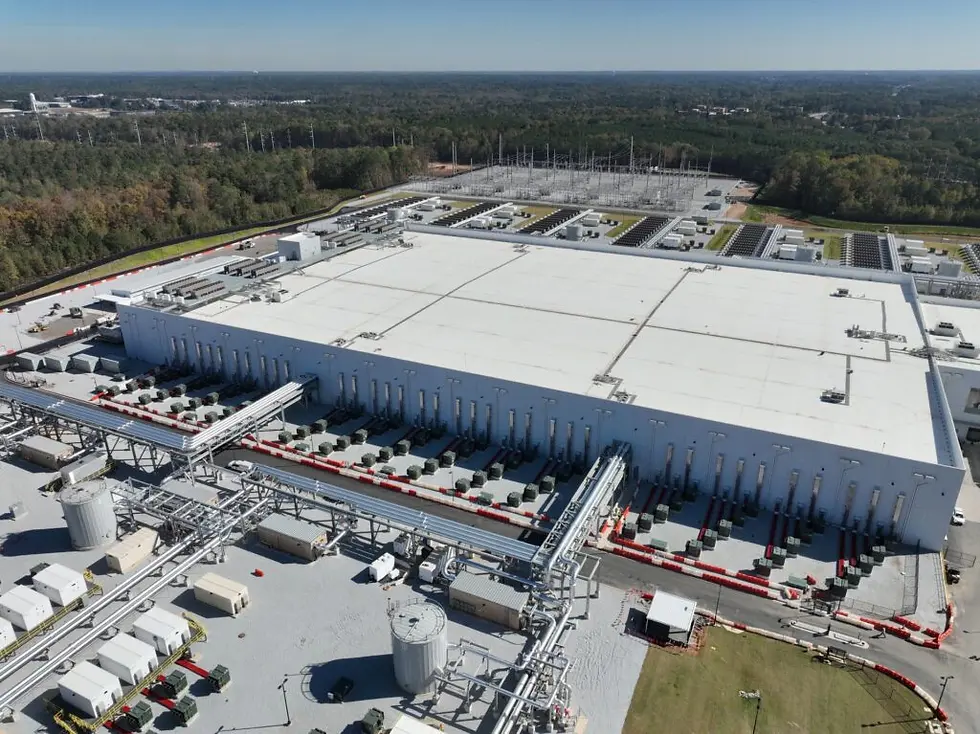
The next phase of AI infrastructure will reward companies that can integrate generation with the rest of the electrical stack.
A turbine or fuel cell is only one layer. A deliverable project may also require:
• Fuel supply and firm transportation;
• Generation redundancy and black-start capability;
• Batteries for instantaneous response and power-quality management;
• Heat recovery or combined-cycle equipment where economics justify it;
• Transformers, switchgear, protection, controls, and SCADA;
• Emissions permitting, water strategy, and community engagement;
• Grid interconnection, islanding, or export capability;
• Long-term service, spare parts, cybersecurity, and performance monitoring.
This is where GX sees its role: connecting globally competitive manufacturing and technology supply chains with U.S. AI infrastructure demand, while keeping the focus on project-level execution rather than isolated equipment sales.
For gas turbines, that means helping customers evaluate not only OEM and model selection, but also the complete chain from critical components and packaging to electrical balance of plant, commissioning, and service. For SOFC, it means recognizing where modular systems create genuine customer value rather than forcing every project into a single technology thesis.
The strongest strategy is not ideological. It is architectural.
Conclusion: The Scarce Asset Is Deliverable Megawatts
Gas turbines are returning to the center of the energy conversation because the AI era needs power that is large, dispatchable, flexible, and operationally proven. Their supply chain—from single-crystal blades to long-term service—is now part of the AI infrastructure story.
But the same shortage that validates demand also creates execution risk. A reservation is not a power plant. A turbine delivery is not a commissioned campus. And a brochure efficiency is not a lifecycle cost.
GX favors gas turbines over SOFC as the backbone for large-scale AI power because they offer the stronger system-level platform at scale. We continue to see SOFC as an important complementary technology where deployment speed, modularity, local air quality, and water constraints carry exceptional weight.
The companies that create the most value will not simply sell equipment into a shortage. They will turn constrained equipment, global supply chains, and complex infrastructure into reliable megawatts—delivered on schedule and supported for decades.
For information only—not investment advice. Performance figures require project-specific diligence.
[1] CPEM Power Generation Think Tank (发电智库), “燃气轮机产业链全景深度解析” [A Panoramic Deep Dive into the Gas Turbine Industry Chain], November 3, 2026. Chinese-language source document supplied for this adaptation.
[2] International Energy Agency, Key Questions on Energy and AI, 2026, including the executive summary and analysis of on-site natural-gas generation. https://www.iea.org/reports/key-questions-on-energy-and-ai/executive-summary
[3] GE Vernova, “GE Vernova Reports Strong Third Quarter 2026 Financial Performance, Raises 2026 Guidance, and Increases Share Repurchase Authorization,” October 28, 2026. https://www.gevernova.com/news/ge-vernova-reports-strong-third-quarter-2026-financial-performance
[4] GE Vernova, “9HA Gas Turbine,” product specifications and hydrogen-capability description. https://www.gevernova.com/gas-power/products/gas-turbines/9ha
[5] GE Vernova, “Gas Power Technology for Data Centers,” including aeroderivative start, modular, mobile, and hybrid applications. https://www.gevernova.com/gas-power/industries/data-centers
[6] CPEM Power Generation Think Tank (发电智库), “燃气轮机产业链全景深度解析” [A Panoramic Deep Dive into the Gas Turbine Industry Chain], November 3, 2026. Chinese-language source document supplied for this adaptation.
[7] International Energy Agency, Key Questions on Energy and AI, 2026, including the executive summary and analysis of on-site natural-gas generation. https://www.iea.org/reports/key-questions-on-energy-and-ai/executive-summary
[8] Bloom Energy, The Bloom Energy Server 6.5, product datasheet, February 2026. https://www.bloomenergy.com/wp-content/uploads/bloom-energy-server-datasheet-feb-2026.pdf
[9] Bloom Energy, “Oracle and Bloom Energy Collaborate to Deliver Power to Data Centers at the Speed of AI,” July 24, 2025. The announced 90-day objective applies to selected Oracle projects and should not be generalized to every SOFC installation. https://investor.bloomenergy.com/press-releases/press-release-details/2025/Oracle-and-Bloom-Energy-Collaborate-to-Deliver-Power-to-Data-Centers-at-the-Speed-of-AI/default.aspx
[10] GE Vernova, “9HA Gas Turbine,” product specifications and hydrogen-capability description. https://www.gevernova.com/gas-power/products/gas-turbines/9ha
[11] Bloom Energy, “Bloom Energy and Oracle Expand Strategic Partnership to Deploy up to 2.8 GW to Accelerate AI Infrastructure Build-Out,” April 13, 2026. https://investor.bloomenergy.com/press-releases/press-release-details/2026/Bloom-Energy-and-Oracle-Expand-Strategic-Partnership-to-Deploy-up-to-2-8-GW-to-Accelerate-AI-Infrastructure-Build-Out/default.aspx
[12] GX Ventures, “How U.S. IRA Subsidies Are Reshaping the SOFC Industry,” including the earlier GX Insight on SOFC and AI infrastructure. https://www.gx-ventures.com/post/how-u-s-ira-subsidies-are-reshaping-the-sofc-industry


Comments