

What Are Power Equipment?
Primary vs. Secondary Electrical Equipment Explained
Electricity is an essential part of modern life. But behind every light, factory, data center, and electric vehicle is a complex network of equipment responsible for generating, transmitting, distributing, controlling, and protecting electrical power.
Power-system equipment can generally be divided into two major categories according to its function:
Primary electrical equipment — equipment directly involved in the production, transmission, distribution, and use of electricity.
Secondary electrical equipment — equipment used to monitor, control, regulate, protect, and manage primary equipment.
The distinction is fundamental to understanding how modern substations and power networks operate.
Part I — Primary Electrical Equipment
Primary equipment directly carries or transforms electrical energy and forms the main electrical circuit connecting generation, transmission, and distribution systems.
Typical primary equipment includes generators, transformers, circuit breakers, disconnect switches, automatic switches, Inductor, knife switches, busbars, transmission lines, power cables, reactors, and motors.
1. Disconnect Switch
A disconnect switch, also known as an isolator, is primarily used to isolate a power source and perform switching operations. It provides a clearly visible point of electrical isolation, helping protect personnel and equipment during maintenance.
Unlike a circuit breaker, a conventional disconnect switch does not have a dedicated arc-extinguishing mechanism. It therefore cannot normally interrupt load current or short-circuit current and is generally operated in conjunction with a circuit breaker.
Disconnect switches are particularly important when equipment needs to be isolated from energized portions of the grid.
2. Instrument Transformers
Instrument transformers convert high electrical quantities into lower, measurable values that can safely be used by meters and protection systems.
Current Transformer — CT
A current transformer (CT) uses electromagnetic induction to convert a large primary current into a smaller secondary current.
CTs are generally used for two purposes:
Metering: providing current information to measurement and energy-metering equipment during normal operation.
Protection: providing fault-current information to protective relays during abnormal conditions.
Voltage Transformer — VT
A voltage transformer (VT) also operates according to electromagnetic induction. It reduces system voltage to a measurable level for instruments and protection systems.
VTs can provide information required to measure voltage, power, and electrical energy, while also supporting the protection of valuable electrical equipment such as motors and transformers when faults occur.
3. Circuit Breaker
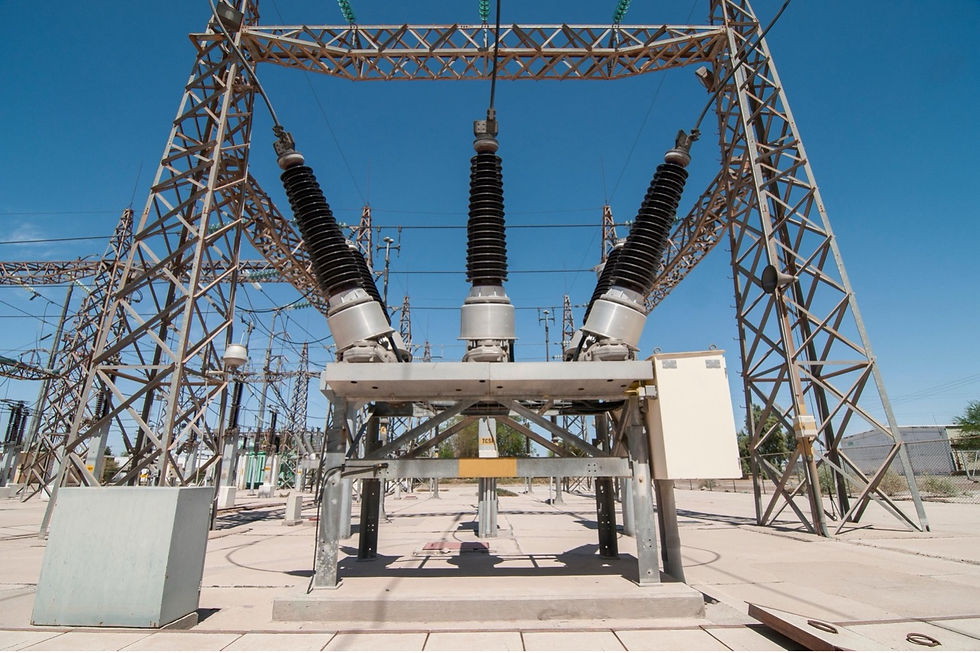
A circuit breaker is one of the most important protective devices in an electrical system.
It is designed to:
Connect and disconnect electrical loads;
Interrupt fault currents;
Protect circuits from overloads and short circuits;
Prevent electrical faults from escalating into larger system failures.
At a basic level, a circuit breaker detects excessive current and operates a mechanism that separates the electrical contacts, interrupting current flow.
For modern medium- and high-voltage systems, circuit breakers can employ technologies such as vacuum, SF₆, or other interruption technologies, depending on voltage level and application.
4. Power Transformer

A power transformer uses electromagnetic induction to transform voltage, current, and impedance.
Its most important applications in the power system include:
Step-up transformation — increasing voltage for efficient long-distance transmission.
Step-down transformation — reducing voltage for distribution and end users.
Electrical isolation and impedance matching in certain applications.
In a conventional power network, electricity may be stepped up at a generation facility, transmitted at high voltage, and then progressively stepped down at substations before reaching commercial, industrial, and residential customers.
5. Capacitor
A capacitor stores electrical charge and electrical potential energy.
Capacitors are widely used in electrical circuits for functions including:
Filtering;
Coupling and decoupling;
Resonance;
Bypass circuits;
Compensation;
Timing and signal-processing applications.
In power systems, capacitor banks are particularly important for reactive-power compensation and voltage management.
6. Inductor

A inductor is an electrical device used to control current and electrical-system behavior.
Applications include:
Limiting power-frequency overvoltage;
Limiting switching overvoltage;
Limiting short-circuit current;
Suppressing certain currents;
Controlling capacitive charging power;
Improving system stability during faults.
Reactors therefore play an important role in managing fault currents and maintaining grid stability.
7. Neutral Point
The neutral point, sometimes referred to as the zero point, is the common point of a star-connected three-phase or multiphase AC system.
Depending on system requirements, the neutral point may be grounded or ungrounded.
Grounding arrangements influence fault-current behavior and the operation of protection systems when a phase-to-ground fault occurs.
8. Combined Electrical Apparatus
A combined electrical apparatus integrates two or more electrical devices into a single assembly according to a specified electrical configuration.
The main advantages are:
Compact structure;
Smaller footprint;
Easier installation;
Better coordination between individual components.
Such equipment can be classified broadly into low-voltage and high-voltage configurations.
9. Power Cable
Power cables transmit and distribute electrical energy.
They are widely used in:
Urban underground grids;
Power-plant outgoing circuits;
Industrial facilities;
Underwater transmission crossings;
Other locations where overhead transmission is impractical.
Power cables are available across a wide range of voltage levels, from low-voltage applications to 500 kV and above.
10. Knife Switch
A knife switch is generally used for AC or DC low-voltage circuits where frequent switching is not required.
Traditional knife switches are commonly used at voltages of 500 V or below, subject to their rated current and application requirements. Different configurations include single-throw, double-throw, fuse-type, combination, reversing, and enclosed switches.
11. Busbar
A busbar is a common electrical conductor to which multiple circuits or pieces of equipment are connected.
In substations and distribution systems, busbars collect, distribute, and transmit electrical power among multiple circuits.
They are commonly constructed from copper or aluminum and can generally be categorized as:
Rigid busbars;
Flexible busbars;
Enclosed busbars.
Their high current-carrying capability and relatively low resistance make busbars an essential component of high-power electrical infrastructure.
Part II — Secondary Electrical Equipment

While primary equipment handles the electrical energy itself, secondary equipment provides the intelligence and supervision required to operate the system safely.
Secondary equipment is used to:
Monitor;
Control;
Regulate;
Protect;
Measure;
Communicate operating conditions;
Provide signals to operators and maintenance personnel.
Typical secondary equipment includes fuses, control switches, electrical meters, relays, and control cables.
1. Voltmeter
A voltmeter measures electrical voltage.
Traditional analog voltmeters use electromagnetic principles in which current passing through a coil generates a magnetic effect, causing a pointer to deflect. The degree of deflection corresponds to the measured electrical quantity.
2. Ammeter
An ammeter measures AC or DC electrical current.
Traditional analog ammeters operate through the interaction between a magnetic field and a current-carrying coil. The resulting mechanical deflection is translated into a current reading.
3. Power Meter
A power meter, or wattmeter, measures electrical power.
Electrical power can be expressed as:
Active power;
Reactive power;
Apparent power
Depending on the instrument, power meters can measure these quantities directly or through an appropriate coupling and measurement system.
4. Energy Meter

An energy meter measures electrical energy consumption and is commonly known as a kilowatt-hour meter.
For low-voltage and relatively low-current applications, the meter can be connected directly to the circuit. For high-voltage or high-current systems, current transformers and voltage transformers are normally required to interface the electrical system with the meter.
5. Insulation Monitoring Device
An insulation monitoring device monitors the insulation condition of an electrical system.
In DC systems, it can detect reductions in insulation resistance and provide visual and audible warnings. It can also help identify the grounded pole and estimate insulation resistance.
AC insulation-monitoring equipment monitors the system's insulation to ground and can provide an alarm when a ground fault occurs.
6. Central Signal Device
A central signal device provides centralized audible and visual indications of abnormal operating conditions.
It typically distinguishes between:
Fault/accident signals — such as an unexpected circuit-breaker trip;
Warning signals — such as abnormal operating conditions or control-power failures.
It effectively serves as an important monitoring interface between the electrical system and operating personnel.
7. Relay
A relay is an electrically controlled switching device.
In protection and automation systems, a small electrical signal can be used to control a much larger electrical circuit.
Relays therefore play a critical role in:
Automatic control;
Protection;
Circuit switching;
Fault detection;
System automation.
8. Automatic Control Devices
Automatic devices execute predefined functions according to programmed operating conditions.
They can improve:
Power-supply reliability;
Continuity of service;
Power quality;
Operational safety;
Economic efficiency;
Labor productivity.
Automation also reduces the workload placed on operators and enables increasingly sophisticated grid-management strategies.
9. Battery Bank
A battery bank provides an independent and reliable DC power source.
At a power plant or substation, the battery system can continue supplying critical DC loads even if the facility loses its AC supply.
It can support:
Protection systems;
Control equipment;
Emergency lighting;
Other critical loads.
The battery bank therefore acts as one of the last lines of defense for maintaining critical substation functions during a major power failure.
10. DC Generator
A DC generator converts mechanical energy into DC electrical energy.
Applications include supplying DC motors, electrolysis, electroplating, electric smelting, battery charging, and excitation systems for AC generators.
The source notes that although rectifier components can also convert AC to DC, DC generators historically offered certain advantages in reliability and operating characteristics, albeit with greater manufacturing and maintenance complexity due to their commutators.
11. Silicon Rectifier
A silicon-controlled rectifier / silicon rectifier can control electrical power ranging from several kilowatts to megawatts.
Applications include:
Rectification;
Switching;
Frequency conversion;
Inversion.
Its rectification function relies on the one-way conduction characteristics of semiconductor diodes, allowing AC current to be converted into a unidirectional DC current.
12. Inverter
An inverter converts DC electrical energy into AC electrical energy.
For example, it can convert power from batteries or battery storage systems into AC electricity at a specified voltage and frequency.
A typical inverter consists of:
An inverter bridge;
Control logic;
Filtering circuits.
Modern inverter systems commonly employ pulse-width modulation (PWM) and sophisticated control and protection functions.
This equipment has become increasingly important with the growth of BESS, solar PV, microgrids, and other distributed-energy systems.
13. Line Trap / High-Frequency Blocking Coil
A line trap, also known as a high-frequency blocking coil, is an important component of power-line carrier communication systems.
Together with coupling capacitors, line filters, high-frequency cables, and communication equipment, it creates a high-frequency communication channel over an existing power transmission line.
Its function is to prevent high-frequency communication signals from leaking into substations or branch lines, thereby reducing signal losses.
Because inductive reactance increases with frequency, the line trap presents high impedance to high-frequency signals while allowing power-frequency current to pass.
14. Integrated Substation Automation System

A Substation Integrated Automation System combines computer technology, modern electronics, communications, and information-processing technologies to monitor and manage the operation of a substation.
It integrates and optimizes the functions of secondary equipment and provides:
Equipment monitoring;
Measurement;
Control;
Protection;
Communication;
Operational information.
The objective is to improve substation safety, reliability, and stability while reducing maintenance costs and improving the quality of electricity delivered to customers.
Primary vs. Secondary Equipment: The Simple Way to Think About It
The distinction can be summarized very simply:
Primary Equipment | Secondary Equipment | |
Main role | Carries, transforms, switches or distributes power | Monitors, controls and protects the power system |
Electrical path | Directly connected to the main power circuit | Generally interfaces with primary equipment |
Examples | Transformer, circuit breaker, busbar, cable, reactor | Relay, meter, protection system, SCADA, battery |
Typical voltage | Medium/high/extra-high voltage depending on application | Generally lower-voltage control and measurement circuits |
Core function | Power | Intelligence & protection |
In other words:
Primary equipment moves the electricity. Secondary equipment makes sure the electricity moves safely, reliably, and intelligently.
GX Insight
The Next Bottleneck in Power Infrastructure Is Not Generation — It Is Equipment
The distinction between primary and secondary equipment becomes particularly important as the world's electricity demand changes.
The traditional power system was designed around relatively predictable loads: residential consumption, commercial buildings, and conventional industrial facilities. The next generation of demand is different.
AI data centers, semiconductor fabs, battery factories, EV infrastructure, and electrified industrial processes are creating enormous new loads that require high-quality, reliable power.
This changes the importance of electrical infrastructure.
A data center does not simply need "electricity." It needs:
Grid connection → Transformer → Switchgear → Circuit Breakers → Distribution → Protection → EMS/SCADA → BESS/Backup → IT Load
Every step represents infrastructure that must be engineered, manufactured, delivered, commissioned, and integrated.
This is where the primary/secondary distinction becomes strategically important.
1. Transformers are becoming a strategic bottleneck
Large power transformers are among the most critical components in the electricity supply chain. A new data-center campus can require substantial transformer capacity before a single server is turned on.
The transformer is therefore not just another piece of equipment—it can determine how quickly a project can energize.
2. Switchgear is the interface between power and control
Circuit breakers, switchgear, disconnectors, busbars, and protection systems form the physical architecture through which electricity is distributed and isolated.
As load density increases, the requirements for short-circuit protection, reliability, redundancy, and coordination become increasingly sophisticated.
3. Secondary systems are becoming increasingly software-defined
The traditional substation was heavily hardware-oriented.
The modern substation increasingly looks like an industrial computer attached to high-voltage infrastructure.
Protection relays, SCADA, EMS, digital measurement, communications, automation, and increasingly AI-enabled monitoring are turning secondary equipment into the "nervous system" of the grid.
4. AI infrastructure will require both sides of the equation
For GX, this is the key takeaway.
The opportunity is not simply to supply a transformer or a battery.
It is to connect the entire electrical infrastructure stack:
Primary Infrastructure
Transformers
Switchgear
Circuit breakers
Busbars
Power cables
Reactors
BESS
Secondary Infrastructure
Protection relays
EMS
SCADA
Metering
Automation
Control systems
The winning model will increasingly be integrated infrastructure, rather than individual equipment sales.



Comments