

Beyond the Shoreline: Why AI Data Centers Are Moving to Sea
From wave-powered AI nodes to 200 MW floating hyperscale platforms, offshore computing is moving from experiment toward infrastructure.
The next frontier of AI infrastructure may not be another industrial park in Northern Virginia, Texas or Southeast Asia.
It may be the ocean.
As artificial intelligence pushes data-center development toward unprecedented levels of power density, developers are running into increasingly physical constraints: electricity, grid interconnection, land, water, construction schedules and community acceptance. The International Energy Agency estimates that global data-center electricity consumption rose to roughly 485 TWh in 2025 and could approach 950 TWh by 2030, while electricity consumption from AI-focused data centers is projected to roughly triple over the same period.
The industry is therefore beginning to challenge one of its oldest assumptions: that the compute must be located on land.
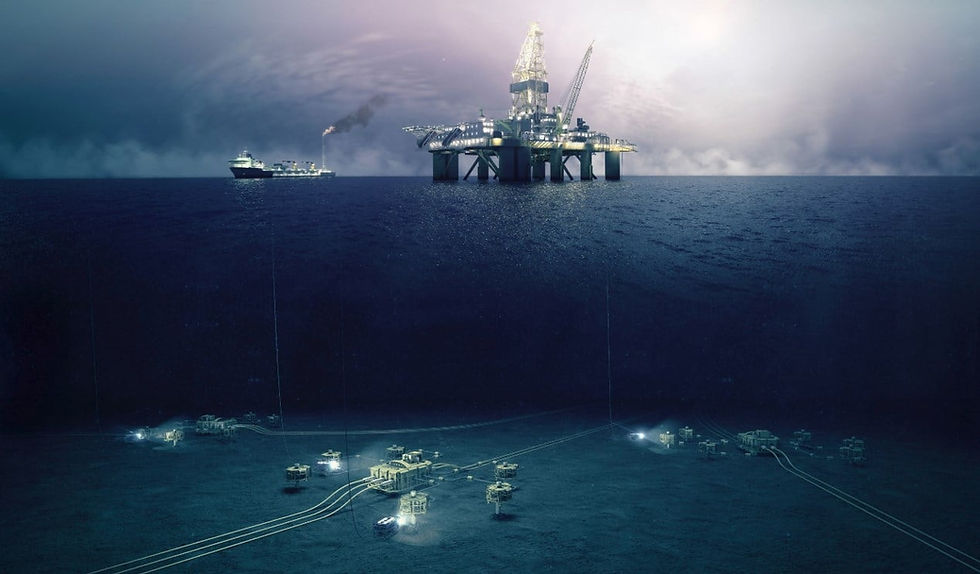
Over the past several months, a surprisingly diverse group of companies — including offshore engineering majors, wave-energy developers, shipbuilders and nuclear startups — have begun developing data centers that float on, or operate within, the ocean.
The concepts are very different. Some resemble conventional hyperscale facilities placed on barges. Others generate their own electricity from waves. Another proposes separating nuclear power ships from floating compute platforms.
What connects them is more important than the technology itself:
Instead of bringing ever-larger quantities of energy, water and infrastructure to the data center, developers are beginning to move the data center toward the energy.
AI Infrastructure Is Becoming a Physical Infrastructure Problem
For most of the cloud era, data-center economics were dominated by servers, networking and real estate.
The AI era changes the equation.
Electricity supply is increasingly becoming the gating factor. The IEA notes that energy infrastructure typically requires much longer development timelines than the data centers themselves, while transformers, turbines, grid connections and other critical components are facing tightening supply constraints.
That creates a fundamental mismatch.
An AI developer may be able to procure GPUs and design a data center in a few years, yet obtaining several hundred megawatts of firm power at the same location can take substantially longer.
The ocean introduces a radically different development surface.
It offers access to enormous renewable-energy resources, existing coastal power infrastructure, industrial ports and shipyards — while potentially reducing dependence on expensive land, potable water and congested terrestrial transmission systems.
Several companies are now testing different versions of that thesis.
Panthalassa: Move the Compute to the Wave

Perhaps the most unconventional approach comes from Oregon-based Panthalassa.
The company raised $140 million in Series B financing led by Peter Thiel in 2026 to manufacture and deploy autonomous ocean-powered computing systems. Its technology combines wave-energy generation with onboard AI computing rather than transmitting the electricity back to shore. That distinction is critical.
Historically, one of the economic problems facing wave energy has been transmission: generating electricity far offshore is of limited value if developers must then construct expensive subsea infrastructure to bring the electrons back to land.
Panthalassa reverses the architecture.
Its floating nodes generate electricity from waves and consume that electricity locally, running AI accelerators onboard. The output — inference results rather than raw electricity — is then transmitted to land through low-Earth-orbit satellite communications.
In effect:
Energy → Compute → Data
replaces
Energy → Cable → Grid → Data Center → Compute.
Panthalassa has spent years developing prototypes including Ocean-1, Ocean-2 and Wavehopper. The company is preparing its Ocean-3 pilot series, with commercial systems targeted after the pilot phase.
The company's own description is even more explicit: its autonomous nodes are designed to generate electricity offshore continuously, consume that energy onboard for AI inference and transmit the resulting tokens by satellite.
This architecture is especially interesting because it treats compute as an energy-conversion product.
If electricity is difficult or expensive to transport but computational output is comparatively easy to transport, moving the workload can become economically preferable to moving the power.
Seatrium: Turning Offshore Engineering Into Data-Center Manufacturing

A second model looks considerably closer to today's data-center industry.
Singapore-based Seatrium is developing a 30 MW floating data center based on six independent 5 MW "Data-in-a-Box" modules installed on a jetty-moored, non-propelled barge. Each module integrates IT equipment, cooling, electrical distribution and supporting infrastructure.
Bureau Veritas granted the design an Approval in Principle (AiP) in July 2026 after reviewing areas including general arrangement, cooling process, preliminary stability, marine systems and key safety considerations. Importantly, Seatrium is already advancing a 100 MW concept, suggesting that the company is thinking beyond pilot scale.
The engineering concept combines three ideas:
modular construction, seawater-assisted cooling and flexible offshore siting.
Each module as integrating the IT stack, cooling system, power distribution and supporting infrastructure into a compact package.
This model may ultimately prove more important to hyperscale operators than the more futuristic deep-ocean concepts because much of the existing data-center architecture can remain intact.
The primary innovation is not necessarily the server.
It is the construction and siting model.
Samsung Pushes the Concept Toward Hyperscale
Developments in August 2026 strengthened that argument considerably.
Samsung Heavy Industries has been working on floating data centers using standardized shipbuilding processes. ABS originally granted Approval in Principle for a 50 MW design in May. On August 4, ABS announced an additional Approval in Principle for Samsung Heavy Industries' 200 MW floating data-center concept — four times the capacity of the earlier platform and clearly aimed at hyperscale requirements.
At the same time, Dallas-based Mousterian Corporation and Samsung Heavy Industries have moved their U.S. initiative from memorandum to engineering work.
Their agreement covers purpose-built floating facilities providing 50 MW of critical IT capacity per unit, with initial deployment planned in Texas and other U.S. markets. The companies say the facilities will support high-density liquid-cooled AI compute and use non-evaporative cooling without consuming potable water.
There is another potentially important advantage: manufacturing.
Because the data center can be fabricated in a shipyard while shoreside work proceeds separately, developers could perform construction activities in parallel rather than sequentially. Samsung and Mousterian are explicitly positioning this as a way to compress time-to-capacity.
This may ultimately be one of the strongest commercial arguments for floating infrastructure.
A floating data center can begin to resemble an FPSO or LNG vessel: engineered once, manufactured repeatedly and deployed where the resource exists.
That is a very different development model from constructing every hyperscale campus as a bespoke terrestrial megaproject.
Mocean Energy: A Modular Renewable AI Fleet
Scottish wave-energy developer Mocean Energy occupies the middle ground between Panthalassa's autonomous open-ocean architecture and the large floating facilities being developed by Seatrium and Samsung.
Its Blue Core concept combines wave generation, offshore solar, battery storage, AI server racks and ocean cooling in a self-contained platform. The source article describes proposed units generating approximately 500 kW to 1 MW, connected through low-Earth-orbit satellite communications and capable of being combined into larger farms.
Mocean's current technical roadmap describes closed-loop chip cooling exchanging heat with the sea, modular units that can be removed individually for maintenance or GPU upgrades, and a small-scale onboard-compute demonstration targeted for 2027.
This points toward an important distinction in offshore compute.
A 500 kW renewable node and a 200 MW hyperscale platform should not be evaluated as competing products.
They serve different workload and infrastructure requirements.
Smaller autonomous systems could be attractive for certain inference, edge, defense, remote industrial or sovereign-compute applications. Large-scale AI training, by contrast, requires enormous quantities of firm electricity and extremely high-bandwidth networking — making near-shore platforms with fiber connectivity and dispatchable generation more natural candidates.
Atomarine: Put the Nuclear Plant on Another Ship
A fourth architecture pushes the idea even further.
Y Combinator-backed Atomarine proposes standardized floating compute barges supplied by separate nuclear-powered vessels.
Its long-term concept separates the data-center asset from the power-generation asset. The company has discussed seawater-based cooling and future nuclear generation, while acknowledging that the reactor technology required for the eventual configuration is not yet commercially proven. The original article notes that its first planned facility would instead use natural gas, targeting deployment around 2028.
Atomarine's current Y Combinator profile similarly describes standardized barges manufactured centrally and a first gas-powered pilot targeted for 2028, with nuclear power vessels envisioned later.
The idea is technically ambitious, but strategically significant.
It separates three infrastructure layers that are usually locked together:power generation, data-center infrastructure and location.
If standardized successfully, a developer could theoretically move either the compute asset or its generation asset as economics, regulation or demand changed.
What Offshore Data Centers Solve — and What They Do Not
Moving computation offshore removes some constraints but creates an entirely new engineering environment.
Constraint | Potential Offshore Advantage | New Offshore Challenge |
Power | Co-location with wave energy, generation assets or eventually nuclear | Firming, redundancy, fuel logistics and generation certification |
Land | Dramatically reduced dependence on scarce industrial land | Marine leases, port access and coastal regulation |
Cooling | Ocean becomes a large heat sink; potable-water consumption can fall sharply | Corrosion, biofouling, heat-exchanger performance and environmental controls |
Construction | Factory/shipyard fabrication enables repeatable modules and parallel construction | Shipyard capacity and marine integration become part of the critical path |
Connectivity | LEO satellite works for certain distributed workloads; nearshore platforms can use fiber | Large AI clusters still require enormous bandwidth and extremely reliable links |
Maintenance | Modules can potentially be swapped or returned to port | Weather windows, vessel access and offshore O&M add cost |
Community impact | Less land competition, water demand and local noise | Environmental, maritime and visual-impact concerns do not disappear |
Scalability | Repeatable 5 MW, 50 MW or larger modules could be deployed as fleets | Bankability requires standardization, insurance and proven operating history |
This is why a low PUE alone will not determine the winner.
A facility with excellent cooling efficiency but difficult maintenance, weak connectivity or intermittent power could still produce expensive compute.
The more relevant AI-infrastructure question is increasingly: How quickly and reliably can usable compute be brought online?
The Industry May Be Splitting Into Three Offshore Architectures
The emerging projects suggest three distinct markets.
Near-shore floating hyperscale infrastructure is the most immediately commercial. Platforms remain close enough to ports, fiber and large generation assets to support conventional cloud and AI workloads while benefiting from shipyard construction and seawater heat rejection. Seatrium and Samsung/Mousterian fit this category.
Autonomous renewable compute is more radical. Panthalassa and Mocean effectively locate compute directly beside an otherwise difficult-to-export renewable-energy resource. These platforms are particularly interesting where the computational result is easier to transmit than the electricity itself.
Floating firm-power infrastructure, including nuclear, could eventually bring hyperscale compute into much deeper offshore environments. But reactor licensing, marine nuclear regulation, financing and operational complexity mean that this pathway remains considerably further from conventional project finance today. Atomarine itself is beginning with gas rather than nuclear.
GX Insight: The Ocean Is Not the Thesis — Energy Mobility Is
GX believes the most important development here is not simply that data centers can float.
It is that AI infrastructure is becoming geographically flexible in response to power constraints.
For decades, electricity systems determined where industrial facilities could operate. The AI economy creates an unusual inversion: some computational workloads are sufficiently valuable and digitally transportable that it may be easier to move the compute toward abundant energy than to move the electricity toward the compute.
That changes how infrastructure should be developed.
GX expects the near-term commercial winner to be near-shore rather than deep-ocean: factory-built floating data centers positioned near ports, fiber infrastructure and existing or dedicated generation. Samsung's move from a 50 MW design toward a 200 MW concept — alongside a U.S. engineering program targeting Texas — is an important signal that maritime data-center architecture is already being considered at hyperscale dimensions.
The deeper-ocean model may follow, but initially for workloads where connectivity requirements are more forgiving and autonomous power creates a genuine economic advantage. Panthalassa's decision to perform AI inference directly where wave energy is harvested is particularly notable because it reframes the infrastructure equation: instead of exporting electrons, export computation.
GX also sees a significant industrial supply-chain opportunity emerging around this architecture.
If floating AI infrastructure scales, the critical ecosystem will extend far beyond GPU manufacturers. It will require transformers, switchgear, power electronics, battery storage, high-density liquid cooling, modular electrical rooms, distributed generation, marine structures, controls, subsea connectivity and increasingly sophisticated energy-management systems.
In other words, the future data-center supply chain begins to converge with the energy, shipbuilding and offshore-engineering supply chains.
That convergence may ultimately matter more than whether the first commercially dominant platform is powered by waves, natural gas, renewables or nuclear.
The industry is transitioning from asking:
“Where can we find enough power for the data center?”
to asking:
“Where is the energy — and how do we bring the compute to it?”
The ocean is one answer.
It may not be the last.
Source: https://mp.weixin.qq.com/s/K16ygEc9Q7XMRwC9KsEykQ; https://mp.weixin.qq.com/s/1IjqDQ-OtMdQogfk8HJA6A


Comments