

Email Didn’t Kill Paper Mail. Renewables Won’t Kill Fossil Fuels Overnight.
The energy transition is not a simple replacement story. It is a redesign of how the world produces, moves, stores, and uses energy.
When email became mainstream, many people assumed paper mail would disappear. It did not.
Email took over the functions where it was clearly better: speed, frequency, cost, and convenience. But paper mail remained useful for legal documents, government notices, packages, formal correspondence, and anything requiring physical delivery.
The old system did not vanish. Its role changed.
That may be a better way to understand the relationship between renewables and fossil fuels.
Renewables are scaling rapidly because they are increasingly strong at producing low-cost electricity. But fossil fuels still serve functions that are harder to replace: high-temperature heat, chemical feedstocks, aviation, shipping, backup power, and existing industrial infrastructure.
The energy transition is therefore not a clean handoff from one system to another. It is a long process of substitution, specialization, integration, and decarbonization.
Renewables Will Win Where Electricity Wins
Renewables are strongest where the energy problem is mainly about producing electrons.
This includes utility-scale solar and wind, distributed solar, battery storage, electric vehicles, heat pumps, clean power for data centers, virtual power plants, and demand-response systems.
In these areas, renewables are not just an environmental preference. They are becoming an economic and infrastructure choice.
As more of the economy electrifies, the share of energy that renewables can serve will expand. This is the most important reason renewables will keep growing: they are attached to the broader electrification of the economy.
Fossil Fuels Will Remain Where Molecules Still Matter

Fossil fuels are harder to replace where the system needs molecules, energy density, or high-temperature heat.
This includes aviation, shipping, petrochemicals, fertilizers, cement, steel, seasonal energy storage, backup power, and remote industrial operations.
Some of these uses will eventually be replaced. Some will be reduced. Some will be served by hydrogen, biofuels, synthetic fuels, nuclear, geothermal, or advanced storage. Some will need carbon capture.
But the timeline will vary by sector.
Passenger cars may electrify much faster than aviation. Power generation may decarbonize faster than cement. Buildings may shift faster than petrochemicals.
The transition is not one race. It is many races happening at different speeds.
The Transition Is Already Changing Fossil Fuels

One of the most unde-rappreciated parts of the energy transition is that it is already changing traditional energy industries from within.
The fossil fuel system is facing pressure from regulators, customers, investors, insurers, and industrial buyers to reduce emissions. That pressure is already showing up in several areas.
Methane reduction is one of the clearest examples. Oil, gas, landfill, agricultural, and industrial methane emissions are becoming major targets for near-term climate action. Reducing leakage, capturing waste methane, and converting methane into useful power can lower emissions while improving energy productivity.
Electrification is another example. Drilling sites, compressors, pumps, offshore platforms, and processing facilities can reduce emissions by replacing diesel engines, gas turbines, and inefficient equipment with cleaner electricity.
Carbon capture may also become part of the toolkit for sectors such as cement, steel, chemicals, refining, and gas processing. It will not be the answer everywhere. But in certain industrial settings, especially where emissions are concentrated, it may be one of the few practical options.
The old energy system also contains assets that may be useful in the new one. Pipelines, wells, ports, subsurface data, drilling expertise, industrial land, and engineering workforces can support geothermal, hydrogen, carbon storage, low-carbon fuels, and industrial decarbonization.
The transition is not only about retiring old assets. It is also about finding new uses for them.
The Future Is Hybrid Before It Is Clean
The communications system became hybrid before it became mostly digital. People used email, paper mail, fax, courier services, digital signatures, online forms, and physical delivery at the same time. Eventually, the balance shifted. But the transition was messy, layered, and practical.
Energy will be the same.
For a long period, the world will rely on a hybrid system: renewables, batteries, geothermal, natural gas, carbon capture, hydrogen, biofuels, nuclear, long-duration storage, demand response, and legacy infrastructure.
That hybridity is not a failure. It is the practical pathway from today’s system to a lower-carbon one.
The risk is not coexistence. The risk is complacency.
Fossil fuels cannot use reliability as an excuse to avoid decarbonization. Renewables cannot ignore the physical challenges of grid reliability, storage, permitting, and industrial heat.
Both sides must become more serious.
Replacement, Reduction, Reinvention
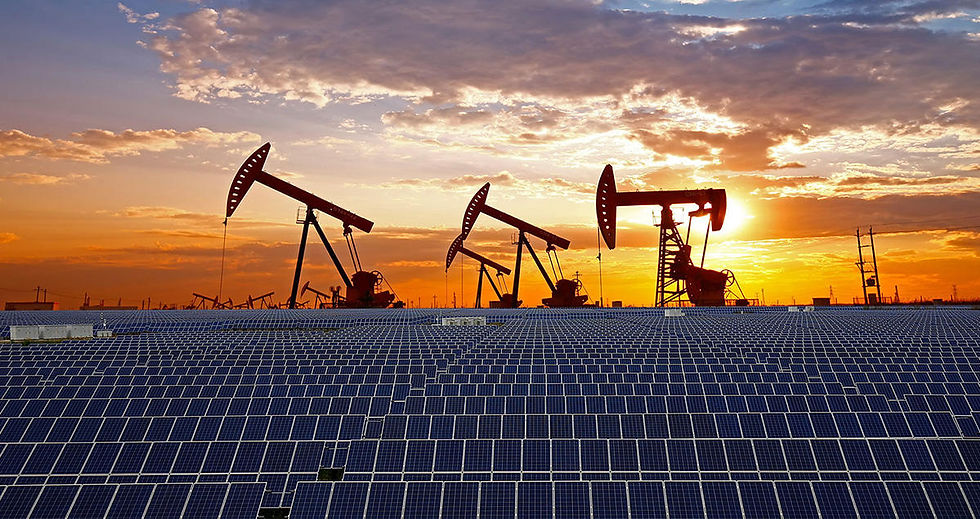
A more useful way to think about the energy transition is through three categories.
First, replacement: renewables and electrification replace fossil fuels where they are already technically and economically superior.
Second, reduction: efficiency, digitalization, demand response, methane control, and operational upgrades reduce the amount of fossil energy needed.
Third, reinvention: existing fossil fuel infrastructure is repurposed or decarbonized. Pipelines can support hydrogen or CO₂ transport. Oil and gas expertise can support geothermal. Depleted reservoirs can support carbon storage. Waste methane can become useful power.
This framework is more realistic than a binary “old versus new” narrative.
The energy transition succeeds when all three happen at once.
Closing
Email did not kill paper mail. It changed what paper mail was for.
Renewables will do the same to fossil fuels.
They will replace fossil fuels in many areas, especially as electricity becomes the dominant carrier of the modern economy. But fossil fuels will remain longer in the sectors where molecules, heat, density, and legacy infrastructure still matter.
The task is not to defend the old system. Nor is it to pretend the new system can replace everything overnight.
The real task is to accelerate the shift: build renewables where they win, reduce fossil fuel dependence where possible, and decarbonize the legacy system where it remains necessary.
The energy transition is not a funeral. It is a rewiring.


Comments